
A type speed test baseline routine is a short measurement cycle that tells you your real starting point before you change drills, keyboard settings, or daily targets. The practical method is simple: hold test conditions steady for seven days, track WPM and accuracy together, and use medians instead of single best runs. You finish with a baseline range you can trust, then train against that range.
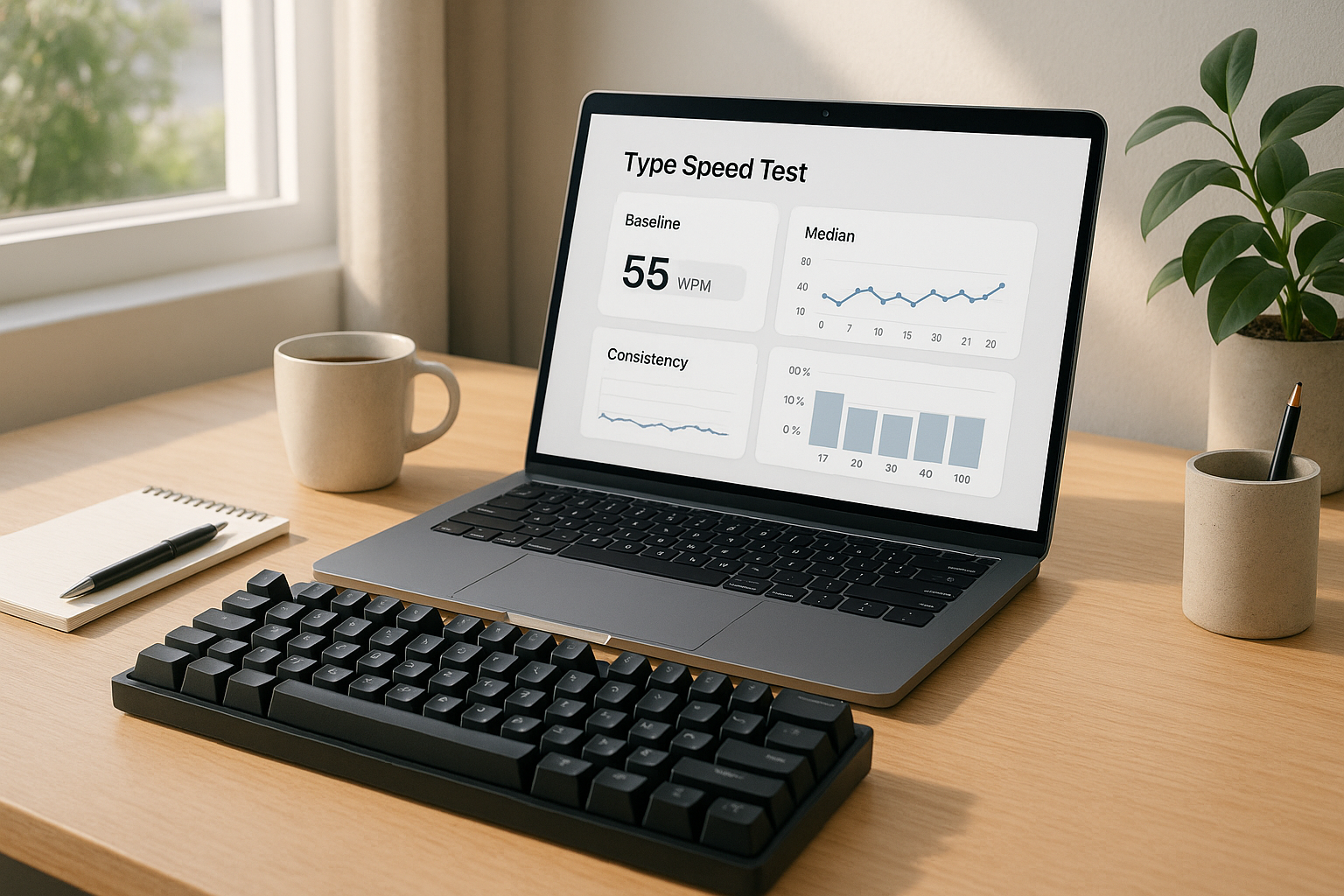
Most typing plans fail at setup. People start with one fast run, pick a new target from that spike, and spend two weeks chasing noise. A baseline routine fixes that sequence. Measurement comes first. Training comes second.
If your recent scores swing hard between test lengths, read Typing Test WPM: Normalize Scores Across Duration and Difficulty first. If you want role-specific target ranges after baseline, use WPM Typing Test Benchmarks by Task: Set Targets That Match Real Work. If your first run of the day is always slow, add Keyboard Typing Test Warmup Protocol: Improve WPM Consistency in 10 Minutes.
# Why a baseline routine improves every type speed test plan
A type speed test score is affected by true skill and short term variance. Variance includes passage difficulty, attention, fatigue, and correction behavior. If you skip baseline collection, you cannot tell whether a later gain came from better skill or easier conditions.
A seven day baseline gives you three useful signals:
- your stable central pace,
- your normal day to day spread,
- your consistency risk, which is how often runs fall outside your expected range.
Those signals support cleaner decisions than a personal best screenshot.
In measurement science, repeated sampling and central tendency are standard tools for reducing random error (NIST engineering statistics handbook (opens new window)). In motor tasks, trial variability is expected and must be modeled before interpreting progress (American Psychological Association dictionary, motor variability (opens new window)).
# What to hold constant during baseline week
A usable type speed test baseline depends on control. You do not need laboratory equipment. You need stable inputs.
Keep these fixed for seven days:
- test duration: 60 seconds for decision runs,
- keyboard and switch mode,
- layout and language,
- seat and desk posture,
- time block, such as morning or evening,
- text source difficulty mix.
Changing two or more inputs at once makes your baseline ambiguous. You can still collect numbers, but they cannot answer causal questions.
If you are testing hardware, freeze hardware during baseline and change one variable only in week two. For keyboard firmware behavior and debounce methods, review your board documentation such as QMK debounce options (opens new window).
# The 7 day type speed test baseline protocol
The protocol below fits into about 12 to 15 minutes per day.
# Daily block structure
- Run a short warmup block for 3 minutes.
- Complete 3 decision runs at 60 seconds each.
- Log WPM, accuracy, and correction notes per run.
- Stop. Do not add bonus runs to chase a higher number.
At three runs per day, you get 21 runs in one week. That is enough to estimate a stable median and a practical spread band.
# What to log for each run
Minimum fields:
- timestamp,
- WPM,
- accuracy percentage,
- backspace intensity tag (low, medium, high),
- short note if context was unusual.
Context notes matter. A late night run after heavy work can explain outliers without forcing you to delete data blindly.
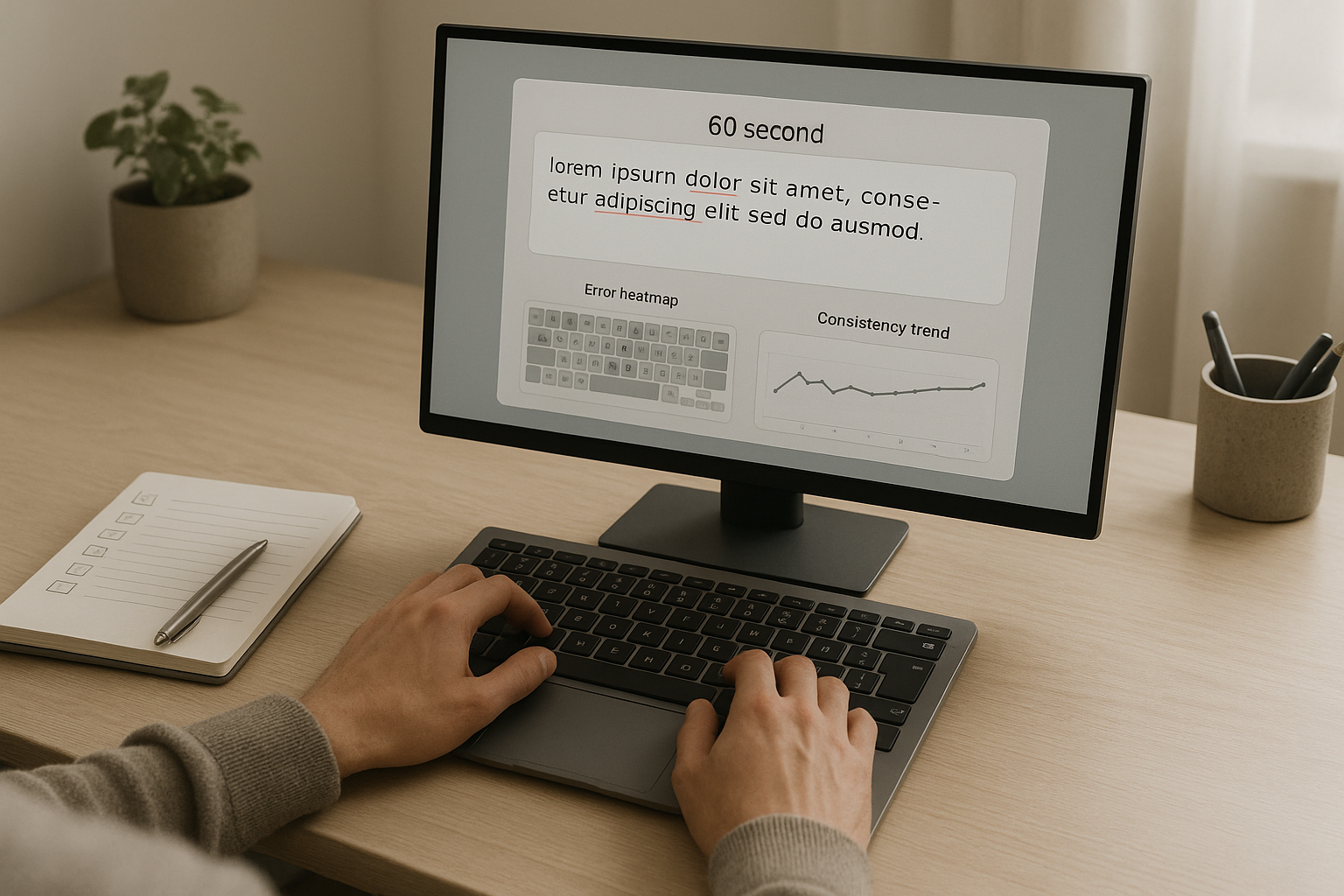
# Decision table: when baseline quality is good enough to train
| Baseline week result | Interpretation | Next action |
|---|---|---|
| Median WPM stable, spread within 8 to 10 WPM, accuracy stable at target floor | Baseline is usable | Start focused training block |
| Median stable but spread above 12 WPM | Measurement quality is weak | Keep routine one more week before changing drills |
| Median rising but accuracy falling | Speed strategy increased correction cost | Hold pace target and add precision drills |
| Large day clusters by time of day | Circadian effect is influencing scores | Split baselines by morning vs evening |
| One day contains obvious outlier context | Data point can be flagged for sensitivity check | Compare with and without outlier before deciding |
Use this table once baseline week ends. Avoid mid week strategy changes unless a setup issue is obvious.
# How to compute a practical baseline range without advanced stats
You can compute a robust baseline in any spreadsheet.
# Step 1: compute median WPM
Median is stronger than average when you have a few unusual runs.
Example 21 run week:
58, 60, 61, 62, 62, 63, 63, 64, 64, 65, 65, 65, 66, 66, 67, 67, 68, 69, 70, 71, 73
Median is 65 WPM.
# Step 2: compute a practical spread band
Use percentile band from the 20th to 80th percentile. This captures normal operation while reducing outlier pull.
In the sample above:
- P20 around 62,
- P80 around 68,
- practical band 62 to 68 WPM.
# Step 3: apply an accuracy floor
Choose a floor based on your target task:
- 97 percent for general writing,
- 98 percent for structured entry,
- 96 to 97 percent for symbol heavy coding flows.
If pace rises but accuracy drops below floor, the gain does not count as usable output.
# Step 4: calculate consistency rate
Consistency rate is the share of runs that land inside your practical band while meeting your accuracy floor.
For example, if 15 of 21 runs are inside band and pass accuracy, consistency rate is 71 percent.
That number becomes your week to week stability indicator.
# Baseline checklist you can copy into your notes
- same keyboard and layout every decision run,
- same run duration,
- three decision runs per day,
- warmup before decision runs,
- WPM and accuracy logged every run,
- context note for unusual sessions,
- median plus percentile band computed at week end,
- consistency rate calculated,
- only then choose next training target.
This checklist prevents most baseline errors with minimal overhead.
# How to turn baseline into weekly targets
After baseline week, target changes should be small and gated.
Use this rule set:
- raise median pace target by 1 WPM only if consistency rate stays at or above 70 percent,
- keep target unchanged if consistency drops below 70 percent,
- lower difficulty or add precision blocks if accuracy floor fails on more than 20 percent of runs.
Small target steps produce cleaner trend signals. Large jumps hide whether your plan worked.
If your baseline indicates high variance, fix stability before chasing raw speed. A stable 64 to 66 WPM with high accuracy usually transfers better to real work than a volatile 60 to 74 spread.
# Common baseline mistakes in type speed test workflows
# Mistake 1: using personal best as baseline
Best run is an achievement marker. It is not a planning baseline. Baseline requires central tendency and spread.
# Mistake 2: mixing test lengths in one dataset
A 15 second run measures burst behavior. A 60 second run measures sustained output. Keep separate datasets for each mode.
# Mistake 3: changing keyboard settings during baseline week
If actuation, debounce, polling, or keycap profile changes mid week, your baseline no longer represents one input system.
# Mistake 4: ignoring correction behavior
Two runs with the same WPM can have very different correction cost. Backspace intensity is a useful proxy when full key logs are unavailable.
# Mistake 5: adding extra runs after a slow score
This creates selection bias because bad runs get overwritten by retries. Keep the planned run count and move on.
# A sample one week baseline log format
Use one row per run:
- date,
- run number,
- WPM,
- accuracy,
- backspace tag,
- context note.
At the end of each day, add:
- daily median WPM,
- daily accuracy median,
- brief note on fatigue or setup quality.
At week end, compute:
- full week median,
- P20 and P80 band,
- consistency rate,
- pass or revise decision.
If you use TypeTest for tracking, keep the same mode and text profile across the full baseline cycle so comparisons remain valid.
# How this baseline method fits with hardware experiments
Baseline first, hardware second.
Week sequence:
- Week 1: baseline with current setup.
- Week 2: change one hardware variable only.
- Week 3: keep the new setting and verify repeatability.
Compare median, band width, and consistency rate across weeks. A hardware change is useful when median improves or band tightens without accuracy degradation.
For low level signal timing context, see keyboard matrix scanning overview (opens new window) and firmware docs for your board. You only need enough detail to design one variable changes.
# Final rule for daily practice
A type speed test baseline routine is a control system. It tells you when to push and when to stabilize. Collect one week of clean data, compute median plus practical band, and treat consistency as a first class metric beside WPM. That gives you a trustworthy starting point and better week to week decisions.